
NIHR Biomedical Research Centre: Oxford

Enabling translational research through partnership

NIHR 20th Anniversary NIHR website
NIHR Biomedical Research Centre: Oxford
  • Home
  • About
    • About us
    • Impact
    • Our next BRC
    • Steering Committee
    • Promoting equality, diversity and inclusion in research
    • Current Vacancies
    • Stay in Touch
    • Contact Us
  • Research
    • Research Overview
      • NIHR Clinical Research Facility
      • Ethics in the NIHR BRC: Oxford
      • Health Economics
      • Medical Statistics
    • Cancer
    • Cardiovascular Medicine
    • Digital Health from Hospital to Home
    • Gene and Cell Therapy
    • Genomic Medicine
    • Imaging
    • Inflammation across Tissues
    • Life-saving Vaccines
    • Metabolic Experimental Medicine
    • Modernising Medical Microbiology and Big Infection Diagnostics
      • Theme overview
      • Infections in Oxfordshire Database (IORD)
    • Musculoskeletal
    • Preventive Neurology
    • Respiratory Medicine
    • Surgical Innovation, Technology and Evaluation
    • Translational Data Science
  • Patient & Public Involvement
    • For patients and the public
    • For researchers
    • More information
  • Training
  • Industry & Partnerships
  • News
  • Events
  • Videos

News

Using AI to improve the quality of endoscopy videos

25 November 2020 · Listed under Cancer, Digital Health from Hospital to Home, Inflammation across Tissues

A multidisciplinary team of researchers has developed a deep-learning framework for improving endoscopy to aid the detection of cancer and other gastrointestinal diseases.
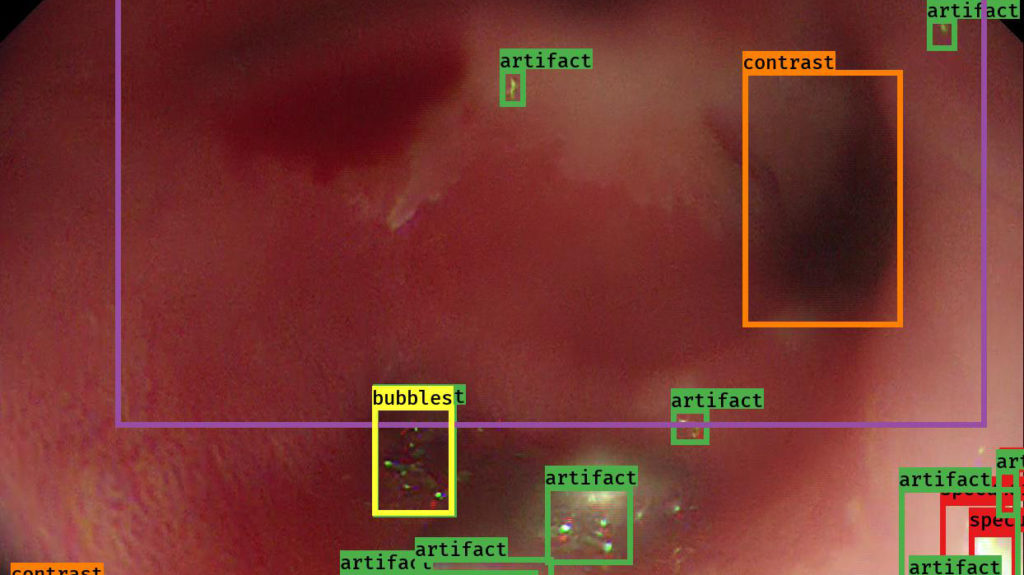
Image from an endoscopy video with the detected artefacts highlighted with coloured boxes.

Cancers detected at an earlier stage have a much higher chance of being treated successfully. The main method for diagnosing cancers of the gastrointestinal tract is endoscopy, when a long flexible tube with a camera at the end is inserted into the body, such as the oesophagus, stomach or colon, to observe any changes in the organ lining.

Endoscopic methods such as radiofrequency ablation can also be used to prevent pre-cancerous regions from progressing to cancer if they are detected in time.

Unfortunately, during conventional endoscopy, the more easily treated pre-cancerous conditions and early stage cancers are harder to spot and often missed, especially by less experienced endoscopists.

Cancer detection is made even more challenging by artefacts in the endoscopy video such as bubbles, debris, overexposure, light reflection and blurring, which can obscure key features and hinder efforts to automatically analyse endoscopy videos.

In an effort to improve the quality of video endoscopy, a team of researchers from the Institute for Biomedical Engineering (Sharib Ali and Jens Rittscher), the Translational Gastroenterology Unit (Barbara Braden, Adam Bailey and James East) and the Ludwig Institute for Cancer Research (Felix Zhou and Xin Lu) have developed a deep-learning framework for quality assessment of endoscopy videos in near real-time.

This framework, published in the journal Medical Image Analysis, is able to reliably identify six different types of artefacts in the video, generate a quality score for each frame and restore mildly corrupted frames.

Frame restoration can help in building visually coherent 2D or 3D maps for further analysis. In addition, providing quality scores can help trainees to assess and improve their endoscopy screening performance.

Future work aims to employ real-time computer algorithm-aided analysis of endoscopic images and videos, which will enable earlier identification of potentially cancerous changes automatically during endoscopy.

This work was supported by the NIHR Oxford Biomedical Research Centre, the Engineering and Physical Sciences Research Council, the Ludwig Institute for Cancer Research and Health Data Research UK.

← New melanoma drug a step closer to the clinic
IBD treatments do not increase susceptibility to COVID-19, study finds →

Other news

News Categories

News by Month

See all news
You are here: Home > Cancer > Using AI to improve the quality of endoscopy videos

Subscribe to the BRC Oxford Newsletter

Keep informed about the work of the BRC Oxford by subscribing to our Mailchimp e-newsletter. It is produced several times a year and delivers news and information about upcoming events straight to your inbox.

Subscribe Now

Feedback

We’d love to hear your feedback. Please contact us at obrcenquiries@ouh.nhs.uk

BRC Oxford on Social Media

  • Bluesky
  • Facebook
  • LinkedIn
  • YouTube
  • Data Control and Privacy
  • Accessibility
  • Our Partners
  • Disclaimer
  • Contact

Copyright © 2026 NIHR Biomedical Research Centre: Oxford