
NIHR Oxford Biomedical Research Centre

Enabling translational research through partnership

MENUMENU
  • About
    • About the NIHR Oxford Biomedical Research Centre
    • Impact
    • Steering Committee
    • Promoting equality, diversity and inclusion in research
    • Current Vacancies
    • Stay in Touch
    • Contact Us
  • Research

        • Research Overview
        • Clinical Research Facility
        • Health Economics
        • Ethics in the NIHR Oxford BRC
        • Medical Statistics
        • Infections in Oxfordshire Database (IORD)
        • 15 Research Themes

        • Cancer
        • Cardiovascular Medicine
        • Digital Health from Hospital to Home
        • Gene and Cell Therapy
        • Genomic Medicine
        • Imaging
        • Inflammation across Tissues
        • Life-saving Vaccines
        • Metabolic Experimental Medicine
        • Modernising Medical Microbiology and Big Infection Diagnostics
        • Musculoskeletal
        • Preventive Neurology
        • Respiratory Medicine
        • Surgical Innovation, Technology and Evaluation
        • Translational Data Science
  • Patient and Public Involvement
    • For patients and the public
    • For researchers
    • More information
  • Training Hub
    • Training Hub Overview
    • Clinical Academic Pathway
    • Internships
    • Pre-Doctoral Research Fellowships
    • Senior Research Fellowships
    • Doctoral Awards
    • Post-Doctoral Awards
    • Pre-Application Programme
    • Other Funding
    • Leadership Training
    • Useful Links
    • Training and Education Resources
    • Upcoming Training Events & Courses
    • Success Stories
  • Industry and Partnerships
    • Collaborate with Oxford BRC
    • Who Do We Work With?
    • Events
    • Partnerships News
    • Further Information and Additional Resources
    • Contacts for Industry
  • Videos
  • News
  • Events

News

You are here: Home > Digital Health from Hospital to Home > Oxford patients take part in study to understand role of stress in managing Crohn’s disease

Oxford patients take part in study to understand role of stress in managing Crohn’s disease

27 June 2019 · Listed under Digital Health from Hospital to Home, Inflammation across Tissues

Around 60 Oxford University Hospitals (OUH) NHS Foundation Trust patients are to take part in a study to look at how wearable and mobile devices can help us to understand the relationship between stress and the symptoms of Crohn’s disease, and help to improve management of the condition.
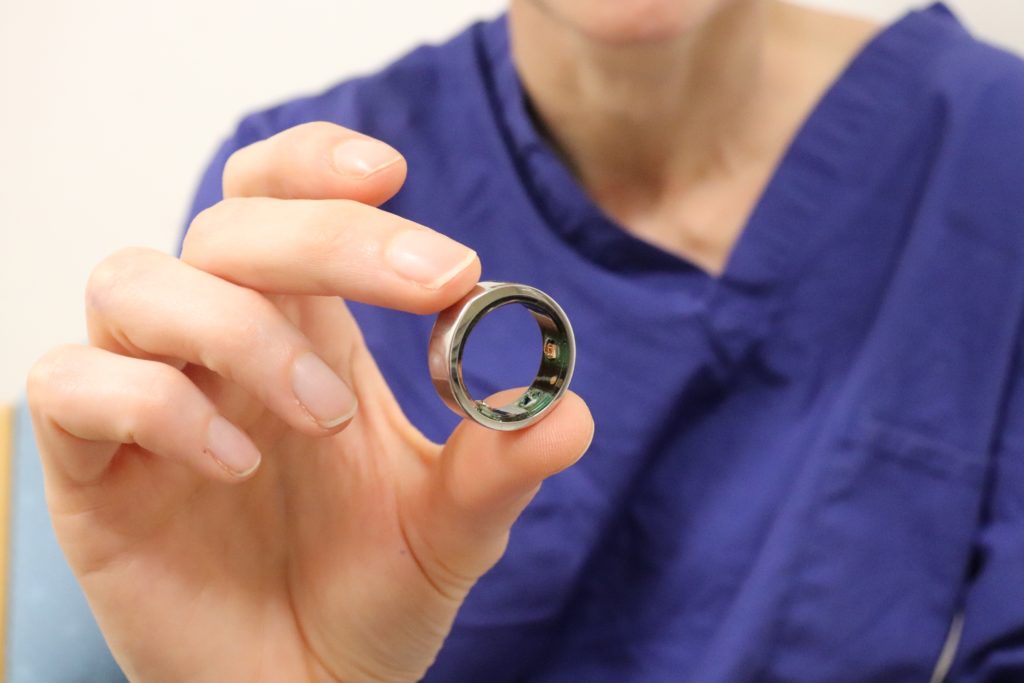
A ‘smart ring’, one of the wearables being used in the Crohn’s disease study.

The research is part of a larger US-based study that uses smart watches, smart rings, smart scales, and smart phones on more than 200 people with Crohn’s disease to track physiological stress signals and correlate these measurements against the symptoms and stress questionnaires that patients record themselves.

The trial will last for six months, with a six-month follow-up period. The wearables will capture a range of physiological data, including cardiovascular output, body mass index, water content and sleep patterns. Alongside this information, patients will complete a range of questionnaires on how they are feeling.

The study is being coordinated by the US company, 4YouandMe, which aims to reduce the burden of chronic diseases through the use of digital devices. This is a collaboration between Oxford and the Mount Sinai Health System in New York, where the man who gave his name to Crohn’s disease, Burrill B. Crohn, worked. The research is supported by the Helmsley Trust Foundation.

“We know there is a relationship between stress, anxiety and depression and the symptoms of chronic, inflammatory conditions like Crohn’s disease. Perceptions of stress are subjective and vary from patient to patient, which has made it hard to study the effects of stress, mood and sleep on the progression of disease,” said Prof Simon Travis, Consultant Gastroenterologist at OUH and Professor of Clinical Gastroenterology at the University of Oxford.

“We’re hopeful that the objective, validated measurements this study provides will reveal correlations between mood and changes in the nature of the disease, to allow us in future to use these digital tools to predict how an individual’s symptoms evolve and help them to take steps to manage their condition,” said Dr Alissa Walsh, Consultant Gastroenterologist working on the project with Prof Travis, whose research into Crohn’s disease and other inflammatory bowel conditions is supported by the NIHR Oxford Biomedical Research Centre.

Ultimately, 4YouandMe plans to develop a forecasting algorithm for Crohn’s disease symptoms by using mathematical models that correlate data on patients’ stress responses with their pattern of disease.

← BRC researchers elected Fellows of Academy of Medical Sciences
Smartphone test predicts how symptoms develop in Parkinson’s →

Other news

News Categories

News by Month

See all news

Subscribe to the Oxford BRC Newsletter

Keep informed about the work of the Oxford BRC by subscribing to our Mailchimp e-newsletter. It is produced several times a year and delivers news and information about upcoming events straight to your inbox.

Subscribe Now

Feedback

We’d love to hear your feedback. Please contact us at obrcenquiries@ouh.nhs.uk

Oxford BRC on Social Media

  • Bluesky
  • Facebook
  • LinkedIn
  • YouTube
  • Data Control and Privacy
  • Accessibility
  • Our Partners
  • Disclaimer
  • Contact

Copyright © 2026 NIHR Oxford Biomedical Research Centre