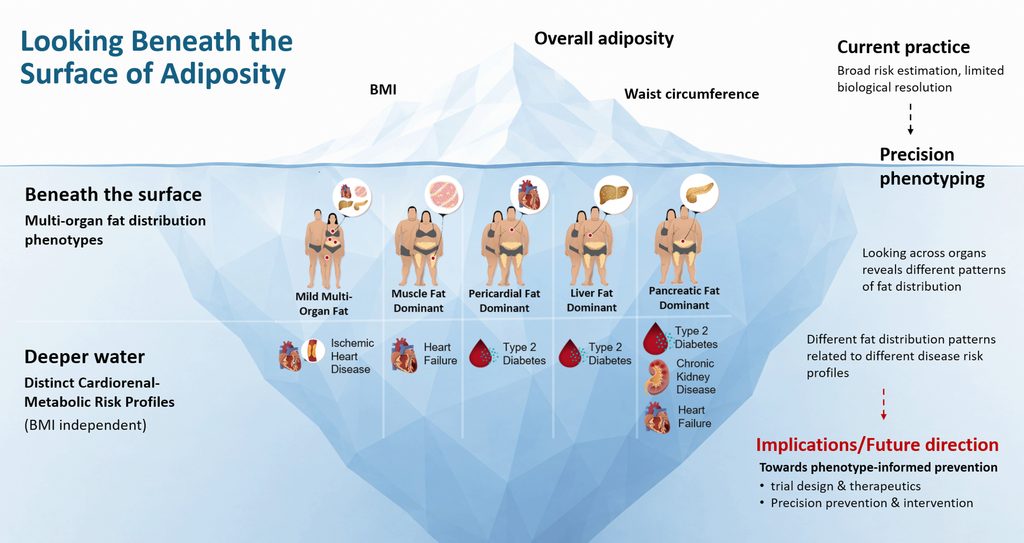
University of Oxford researchers have found that how fat accumulates in the body is just as important for identifying different health risks as a person’s overall weight. They say their findings suggest that looking at how fat is distributed across the whole body, including in and around multiple organs, could help identify people at higher risk and support more personalised prevention and treatment in future.
The study, published in the European Heart Journal and presented at the European Society of Cardiology Congress in Munich, was supported by the National Institute of Health and Care Research (NIHR) Biomedical Research Centre (BRC): Oxford and the NIHR BRC: Barts.
Using detailed magnetic resonance imaging (MRI) scans from almost 25,000 UK Biobank participants, the research team found six distinct patterns of fat build-up across various organs and areas of the body, including the liver, pancreas, heart, muscles and abdominal compartments. These patterns were linked to differences in body composition, heart structure and future risk of disease.
Lead author of the study, Dr Yeshe Kway, of the Radcliffe Department of Medicine’s Division of Cardiovascular Medicine, said: “Increased accumulation of body fat is an important risk factor for several health conditions, including type 2 diabetes, chronic kidney disease and heart disease. But body weight or body mass index (BMI) is just part of the story – two people with a similar BMI can have very different patterns of fat accumulation across their organs and tissues, as well as differences in muscle health, and these differences are linked to distinct risks of future cardiometabolic diseases.
“In this study, we wanted to build a more holistic picture of how fat is distributed across various organs and tissues, and determine whether this could help us better understand differences in future disease risk. By identifying different patterns of fat build-up and linking them to changes in the heart and risk of cardiometabolic diseases, we hope that this approach could ultimately help shift healthcare from reacting to established disease towards earlier, more personalised prevention based on an individual’s risk profile.”
The six clusters of fat build-up profiles were:
- Reference pattern: People who, on average, were within the normal weight range and had the lowest levels of fat across the areas measured (used as a comparison point).
- Mild multi-organ fat pattern: People with slightly increased fat in several organs while, on average, still having a ‘normal’ body weight. This group shows that organ fat can be present even when overall BMI is not high.
- Muscle fat dominant pattern: People with more fat under the skin and in the muscles, rather than deep within the abdomen. This group also had lower muscle mass and function, compared with the reference group.
- Heart-area fat dominant pattern: People with more fat around the heart, along with higher levels of fat in other organs and more fat stored deep inside the abdomen.
- Liver fat dominant pattern: People with the highest average BMI, all showing signs of fatty liver. This group also had the highest prevalence of high blood pressure and type 2 diabetes.
- Pancreatic fat dominant pattern: People with more fat in the pancreas and higher levels of fat in other organs, especially the liver. This group showed signs of lower muscle mass and function.
These profiles were linked to different patterns of future health risk. People in the pancreatic fat-dominant group had a higher risk of type 2 diabetes, chronic kidney disease and heart failure, even after accounting for BMI. People in the liver fat-dominant had the highest risk of type 2 diabetes.

The muscle fat-dominant group was associated with a higher risk of heart failure. They tended to have more fat within muscle and lower measures of muscle health, leading researchers to suggest that the findings may point to an important link between fat distribution, muscle health, and the development of heart problems.
The liver fat-dominant and heart-area fat-dominant groups did not show the same increase in heart disease risk, but they were linked to distinct changes in the structure of the heart. These changes offer clues to how patterns of fat distribution relate to the heart before heart disease develops.
Some findings challenged simple assumptions about weight and health. The mild multi-organ fat group had an average BMI in the normal range but still showed an increased risk of chronic ischaemic heart disease, a condition caused by reduced blood flow to the heart.
Qiang Zhang, Associate Professor of AI in Cardiovascular Imaging in the Radcliffe Department of Medicine, commented: “This study demonstrated how big data approaches at population scale can unveil more insights about patterns of fat distribution and how they contribute to disease risks.
“We believe our findings support a more personalised approach to assessing health risks related to body fat distribution. Rather than treating excess weight as a single condition, we may need to consider which organs are affected, how fat is distributed and whether muscle health is also reduced. Ultimately, this is aimed at identifying those at risk much earlier, allowing us to use more targeted prevention and treatment approaches for many common cardiometabolic diseases.”
The researchers say their future research will look to confirm these findings in different populations and explore whether simpler measures, such as routine clinical tests or more accessible scans, can identify similar risk patterns.