
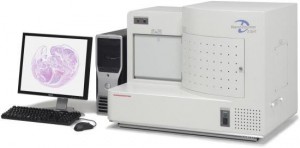
A Hamamatsu high throughput digital slide scanner along with a sophisticated image analysis package from iPath is now available to researchers. The Hamamatsu NanoZoomer 2.0-HT slide scanner enables researchers to digitise their glass slides allowing the images to be interpreted on a screen with ... READ MORE
News Archive
Doctoral student commended
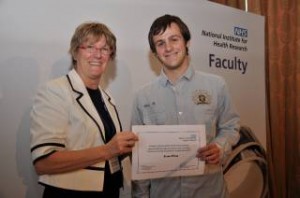
Congratulations to Sean Elias, a doctoral student at the Jenner Institute. He is pictured receiving a 'highly commended' prize for his oral presentation at the NIHR Training Camp this summer from Professor Dame Sally Davies, the Chief Medical Officer and Head of the National Institute for Health ... READ MORE
Patients to benefit from more than £95m in research funding
Leading medical researchers in Oxford have been recognised for their outstanding contribution to healthcare research by the National Institute for Health Research (NIHR) today by being awarded £95m, an increase of 50%, to support translational research. The NIHR Biomedical Research Centre, Oxford ... READ MORE
Researchers trial new drug for women with hereditary breast and ovarian cancer
A CANCER RESEARCH UK-funded trial of a new drug for patients with advanced breast or ovarian cancer due to inherited gene faults has been launched at the Oxford Experimental Cancer Medicine Centre (ECMC) at the University of Oxford. The trial, led by a team based at the National Institute for ... READ MORE
New two-drug approach to treat type of respiratory disease
A therapy combining two existing drugs could provide an effective new approach for treating patients with pleural infections, a serious condition where infected fluid builds up in the space between the ribs and lungs. A randomised clinical trial conducted by Oxford University researchers in the ... READ MORE
Small molecules found to play complex role in cancer metastasis
While they may be small in size, a family of tiny molecules called microRNAs could potentially play a large role in the process of cancer metastasis, or the spread of cancer from one area of the body to another. A team of researchers from The Cancer Institute of New Jersey (CINJ) and Princeton ... READ MORE
JR is home to UK’s most powerful scanner
On Sunday 31st July weighing in at 35 tonnes, the new 7 Tesla magnet scanner was lowered into place by a crane through the ceiling of the Oxford Centre for Functional MRI of the Brain (FMRIB) where it will be used for clinical trials into to help researchers further understand brain disorders, such ... READ MORE
Professor Peter Ratcliffe and oxygen levels
To mark the 75th anniversary of the death of Henry Wellcome and the founding of the Wellcome Trust, they are publishing a series of 14 features on people who have been significant in the Trust’s history. In this final piece, science writer Anjana Ahuja looks at Peter Ratcliffe, the Professor of ... READ MORE
Gas license helps lung patients
The Radiology Department at the Churchill Hospital (part of the Oxford Radcliffe Hospitals NHS Trust) has just been licensed to manufacture Hyperpolarised Xenon gas for patient use. This is only the second site in the UK to be granted permission to use the gas for lung imaging. Clinical trials ... READ MORE
Patients tell of their experience of TIAs and minor strokes

Healthtalkonline is a website that provides a rich resource of more than 2,000 people's experiences of health and illness. It’s also a great source of reliable information about conditions, treatment choices and support. Adding to the growing list of diseases covered by Healthtalkonline is a new ... READ MORE
Formal collaboration announced
The University of Oxford and the Oxford Radcliffe Hospitals NHS Trust have signalled their intention to cement and strengthen their collaboration in research, teaching and patient care by agreeing terms for a formal and legally-binding relationship. There has been a long history of joint working ... READ MORE
Joint funding for multiple sclerosis research
The Oxford Biomedical Research Centre and the MS Society have joined forces to fund a three year Clinical Research Fellowship to carry out translational research into basic or clinical aspects of multiple sclerosis (MS). The collaboration will support the research of Dr Oliver Leach, based within ... READ MORE
The Times Cheltenham Science Festival 2011
Once again the Oxford Biomedical Research Centre (OxBRC) will be sponsoring Professor Russell Foster and his talk on The Rhythm of Life on Wednesday 8 June (2.30-3.30pm) at this year’s Times Cheltenham Science Festival. Cheltenham Town Hall and Imperial Gardens will be transformed between 7-12 ... READ MORE
Rare tumour’s ‘fingerprint’ used to develop cheap and reliable new test
Researchers at the University of Oxford have developed a cheap and reliable diagnostic test for a rare form of cancer. The test involves screening tumour samples for a particular molecular fingerprint unique to this cancer. Hereditary leiomyomatosis and renal cell cancer (HLRCC) is a disorder ... READ MORE
What can be done about the rising risk of antibiotic resistance?
On December 11th 1945, at the end of his Nobel lecture, Alexander Fleming sounded a warning. Fleming’s chance observation of the antibiotic effects of a mould called Penicillium on one of his bacterial cultures had inspired his co-laureates, Howard Florey and Ernst Chain, two researchers based in ... READ MORE
Painful periods research
Women with painful periods show increased sensitivity to pain throughout their cycles, even when there is no background period pain. The brain imaging study carried out at Oxford University shows that period pain is associated with differences in the way the brain processes pain, and that these ... READ MORE
Final child vaccinated in clinical trial of new TB vaccine
The vaccination of the final child marks a significant milestone in the development of the MVA85A/AERAS-485 vaccine candidate, the most advanced of any of the new generation of preventative TB vaccines currently being investigated. Tuberculosis kills 1.8 million people per year, and more than 2 ... READ MORE
New chromosome counting technique
The first babies have now been born in the UK using a new technique pioneered at Oxford University to select the best embryos for IVF. The advance could bring hope to many British couples struggling to have a child and going through many cycles of IVF treatment. The technique used called ... READ MORE
Researchers inspire the next generation
Secondary school students and their teachers were kept on the edge of their seats with a fun an interactive session at the John Radcliffe Hospital on Thursday 17th March. Researchers, scientists, nurses and engineers were on hand with props to try and get the students from schools across ... READ MORE
Bringing together cancer research institutions in Oxford
A new cancer centre has opened in Oxford to bring together the city's different research institutions. The building on Roosevelt Drive is part of a network of 16 units across the country funded by Cancer Research UK. This centre, which will link the University of Oxford, Oxford Radcliffe ... READ MORE
- « Previous Page
- 1
- …
- 44
- 45
- 46
- 47
- 48
- …
- 50
- Next Page »