
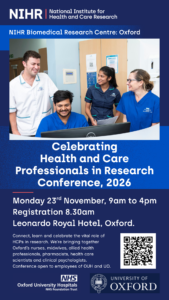
We would like to invite you to join us for our annual celebration of HCPs research. We’re delighted to be showcasing and celebrating research activities from Oxford University Hospitals NHS Foundation Trust by their nurses, midwives, allied health professionals, healthcare scientists, pharmacists ... READ MORE
Partnerships, Planning and Service Provision: Case Studies in Inclusive Research
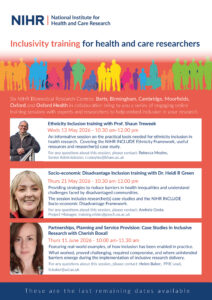
Online Training: Partnerships, planning and service provision with Cherish Boxall This webinar features separate case reflections from researchers and service partners, each sharing real-world examples of inclusive research delivery. Speakers will discuss not only what worked, but also what ... READ MORE
NIHR Oxford BRC Statistics Hub webinar
Estimation methods for treatment policy strategies in clinical trials with missing data: introducing retrieved dropout reference-base centred multiple imputation Schedule: The talk will be approx. 1 hour, with discussion/Q&A 30 minutes Location: Hybrid – Online via Teams / or in ... READ MORE
NIHR BRC Oxford three-day writing retreat (6, 7 and 8 May 2026)
This three-day writing retreat is open to all healthcare professions (nurses, midwives, allied health professionals, clinical psychologists, pharmacists, healthcare scientists and medical practitioners) at any career stage, working at Oxford University Hospitals NHS Foundation Trust or the ... READ MORE
Early pregnancy screening resulted in earlier detection for 40% of anomalies

Unequal access to early pregnancy scans delays detection of serious conditions. Early screening resulted in earlier detection for 40% of anomalies, including heart and limb issues. Researchers from the University of Oxford, supported by NIHR Oxford Biomedical Research Centre, together with ... READ MORE
Study finds no increased safety risk for obese patients undergoing shoulder replacement surgery
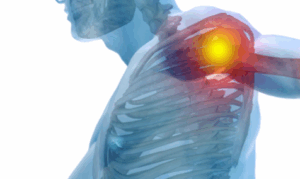
Higher Body Mass Index (BMI) is not linked to increased risk of death or other complications following shoulder replacement surgery, according to a new study by University of Oxford researchers. Joint replacement surgeries - including hip, knee and shoulder replacements - can significantly ... READ MORE
Webinar – Socio-economic Disadvantage Inclusion Training
with Dr Heidi R Green. This is the final webinar in a 3-part series of online inclusivity training sessions for health and care researchers organised by six NIHR Biomedical Research Centres: Barts, Birmingham, Cambridge, Moorfields, Oxford and Oxford Health, with the aim of helping you to help ... READ MORE
Webinar – Ethnicity Inclusion for health and care researchers
with Prof. Shaun Treweek This is the second in a three-part series of online inclusivity training sessions for health and care researchers organised by six NIHR Biomedical Research Centres: Barts, Birmingham, Cambridge, Moorfields, Oxford and Oxford Health, with the aim of helping you to help ... READ MORE
FREE Public Talk – Why are more younger people having strokes?
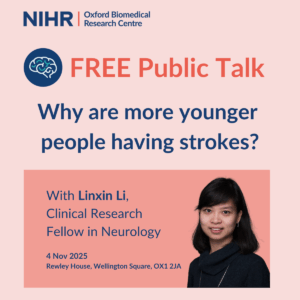
Stroke is a leading cause of death and disability. It is often thought of as something that happens only at older ages. But more and more, we see young adults in their 20s, 30s, 40s suffering from stroke. Why is this happening? Are strokes really becoming more common at younger ages, or are we ... READ MORE