
Researchers at the University of Oxford have identified a promising new RNA-based therapeutic approach that can reverse established atrial fibrosis. Atrial fibrosis is a major contributor to atrial fibrillation, the most common heart rhythm disorder.
The study was led by the University of Oxford and supported by the NIHR Biomedical Research Centre: Oxford and the British Heart Foundation (BHF), with contributions from Baylor College of Medicine in the United States and other international partners.
Atrial fibrillation affects millions of people worldwide and significantly increases the risk of stroke, heart failure and premature death. Current treatments can help control heart rhythm and reduce complications, but there are no approved therapies that directly reverse atrial fibrosis, the structural scarring of the heart that can make atrial fibrillation progress and recur.
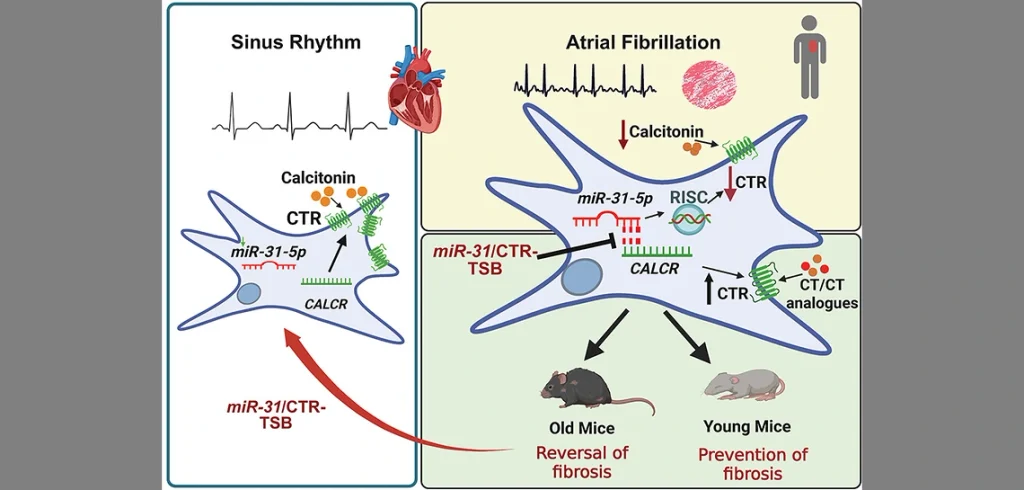
In the study, published in Nature Cardiovascular Research, researchers identified a small RNA molecule that regulates gene expression, miR-31-5p, as a key driver of atrial fibrosis. The team showed that miR-31-5p suppresses a natural process, mediated by the calcitonin receptor (CTR), that protects against scarring. This suppression promotes the activation of fibroblasts ( the main cell type in connective tissue), fibrosis and increased susceptibility to abnormal heart rhythms.
Using a highly selective RNA-based therapeutic approach, the researchers blocked the interaction between miR-31-5p and calcitonin receptor messenger RNA. In preclinical models, this not only prevented the development of fibrosis, but also reversed established atrial fibrosis and reduced problems with abnormal heart rhythms.
The findings identify the miR-31-5p/CTR pathway as a promising therapeutic target and provide proof-of-concept for a new class of precision RNA therapies aimed at treating the underlying structural changes that drive atrial fibrillation.

Professor Svetlana Reilly, Associate Professor of Cardiovascular Science at the University of Oxford and senior author of the study, said: “Atrial fibrosis is a major unmet clinical problem in atrial fibrillation, and currently we have no therapies that directly target the scarring process itself. Our findings suggest that selective RNA-based therapies could offer a completely new way of treating the disease. Rather than simply controlling heart rhythm, we may be able to target and potentially reverse the structural changes that underpin arrhythmia progression.”
The research team say this research points to the potential to improve long-term outcomes for patients and enhance the effectiveness of existing treatments for atrial fibrillation. However, further work is required to identify and optimise a lead RNA therapeutic candidate, evaluate safety and efficacy in preclinical studies, and determine its suitability for future clinical development.