
NIHR Biomedical Research Centre: Oxford

Enabling translational research through partnership

NIHR 20th Anniversary NIHR website
NIHR Biomedical Research Centre: Oxford
  • Home
  • About
    • About us
    • Impact
    • Our next BRC
    • Steering Committee
    • Promoting equality, diversity and inclusion in research
    • Current Vacancies
    • Stay in Touch
    • Contact Us
  • Research
    • Research Overview
      • NIHR Clinical Research Facility
      • Ethics in the NIHR BRC: Oxford
      • Health Economics
      • Medical Statistics
    • Cancer
    • Cardiovascular Medicine
    • Digital Health from Hospital to Home
    • Gene and Cell Therapy
    • Genomic Medicine
    • Imaging
    • Inflammation across Tissues
    • Life-saving Vaccines
    • Metabolic Experimental Medicine
    • Modernising Medical Microbiology and Big Infection Diagnostics
      • Theme overview
      • Infections in Oxfordshire Database (IORD)
    • Musculoskeletal
    • Preventive Neurology
    • Respiratory Medicine
    • Surgical Innovation, Technology and Evaluation
    • Translational Data Science
  • Patient & Public Involvement
    • For patients and the public
    • For researchers
    • More information
  • Training
  • Industry & Partnerships
  • News
  • Events
  • Videos

News

Royal visit to Oxford’s Churchill Hospital

6 December 2012 · Listed under Cancer, Surgical Innovation, Technology and Evaluation

The Duke of York visited the Churchill Hospital in Oxford today to mark the opening of the new building.

The building, that includes an integrated Cancer and Haematology Centre, provides a base for many NIHR Oxford Biomedical Research Centre projects.

Chairman of Oxford University Hospitals NHS Trust, Dame Fiona Caldicott said: “We were absolutely delighted to welcome The Duke of York, to our hospitals today.

“Our staff, patients, fundraisers and volunteers all help to make the Churchill the fantastic hospital that it is, and we were very proud to be able to show His Royal Highness our new hospital building and the way in which research and education informs and improves our patients’ treatment.”

During his visit to the building His Royal Highness visited theatres where Professor Freddie Hamdy, who leads the Oxford BRC’s surgical innovation and evaluation theme, demonstrated robotic surgery.
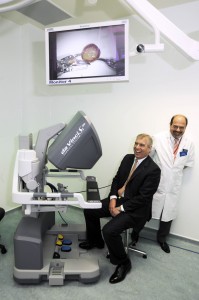
Cutting edge: Professor Freddy Hamdy demonstrates robotic surgery to the Duke of York

His Royal Highness then met patients on the Jane Ashley Ward.

The Duke of York and the Lord Lieutenant of Oxfordshire Tim Stevenson were accompanied on the visit  by Dame Fiona Caldicott, Sir Jonathan Michael, the Chief Executive of Oxford University Hospitals, and by Professor Andrew Hamilton, Vice-Chancellor of the University of Oxford.

Following the tour of the building His Royal Highness was introduced to staff from the NHS and the University, and invited guests.

The Duke of York then unveiled a plaque commemorating the opening of the new building at the Churchill Hospital.

The Churchill Hospital is a centre of excellence for cancer services and medical and surgical specialties including renal and transplant, oncology, haematology, dermatology, haemophilia, infectious diseases, and chest medicine. It also incorporates OCDEM (the Oxford Centre for Diabetes, Endocrinology and Metabolic Medicine).

The new building was completed in 2009.

← Gene therapy trial begins for blindness caused by choroideraemia
Device keeps human liver alive outside body →

Other news

News Categories

News by Month

See all news
You are here: Home > Cancer > Royal visit to Oxford’s Churchill Hospital

Subscribe to the BRC Oxford Newsletter

Keep informed about the work of the BRC Oxford by subscribing to our Mailchimp e-newsletter. It is produced several times a year and delivers news and information about upcoming events straight to your inbox.

Subscribe Now

Feedback

We’d love to hear your feedback. Please contact us at obrcenquiries@ouh.nhs.uk

BRC Oxford on Social Media

  • Bluesky
  • Facebook
  • LinkedIn
  • YouTube
  • Data Control and Privacy
  • Accessibility
  • Our Partners
  • Disclaimer
  • Contact

Copyright © 2026 NIHR Biomedical Research Centre: Oxford