
An Oxford BRC researcher is playing a leading role in a new national NHS programme to use machine perfusion to preserve and assess organs for transplantation.
Professor James Hunter, Associate Professor of Transplant Surgery and lead for the Oxford BRC surgical sub-theme looking at organ assessment and repair, has been named the national lead for the kidney arm of the pilot assessment and recovery centres (ARC) set up by NHS Blood and Transplant.
The initiative will feature pilot ARCs facilities focused on liver and lung, as well as kidney. They will use machine perfusion to preserve and assess organs that would otherwise not be transplanted. A successful pilot could lead to a nationally commissioned service with the ability to recondition organs – the first such national network in the world – enabling up to 750 additional organ transplants to be conducted each year.
Each year hundreds of people in the UK die waiting for a transplant. At the same time, hundreds of potential donor organs are not retrieved or transplanted because there is such a limited time to assess how well they could function. There are more than 8,000 people on the transplant waiting list.
Professor Hunter said: “The problem in transplantation at the moment is that the population of donors is getting older, with an increasing number of medical comorbidities. We are seeing fewer donors and more people waiting for transplants – and that gap is widening.
“The ARC programme is designed to give clinicians confidence that these ‘marginal’ organs are going to work well. Until now, there hasn’t been a reliable way of assessing them, so they are often declined. The ARC aims to use this novel perfusion technology, which allows more time to carry out the necessary tests to ensure the organs are functioning well and in as optimal condition as possible for transplantation.”
The pilot is trialling regional hubs specialising in organ perfusion, where an oxygenated blood-based solution is circulated through organs, allowing their function to be assessed. It also removes waste products from the organ to help maintain it at body temperature and enable it to be preserved for longer, allowing more time for assessment, so more organs can be accepted for transplant. In a full ARC model, organs could also receive additional reconditioning treatments – such as surgical repairs, medication, blood group alteration or cell therapies.
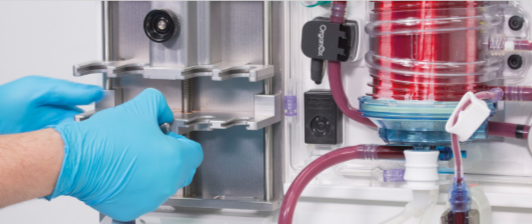
The research conducted by the BRC sub-theme that Professor Hunter leads ties in very closely with the aims of the ARC. Much of the evidence underpinning what can be achieved with organ perfusion was developed in Oxford and resulted in the spin-out company OrganOx, which was recently acquired by the Japanese company Terumo for US$1.5 billion, the largest acquisition of an Oxford University spin-out to date.
Professor Hunter said: “Oxford has always been at the forefront of research into organ perfusion and preservation. The ARC is the clinical translation of that. We have been talking about developing an ARC over the past five years as part of our research and clinical ambition, and it’s really pleasing to see that this has now become a nationally commissioned pilot. We would like as many organs that are retrieved as possible being utilised to save lives.”
He is excited about his role leading the kidney part of the ARC pilot, where he will manage the direction of the programme and oversee clinical delivery of the kidney ARC, which will include up to five pilot centres across the UK.
“This pilot will feed into how an eventual commissioned service will look. And obviously, in Oxford we are very keen to be more than just an ARC pilot. We want to be a fully-fledged ARC in future,” he said.