

Blog by Professor Helen McShane, Director of the NIHR Biomedical Research Centre: Oxford
This year marks the 20th anniversary of the National Institute for Health and Care Research (NIHR). Its creation was a landmark moment; not only did it establish a system for funding high quality research in the NHS to “improve the health and wealth of the nation”, it also made explicit the connection between basic discovery science and the treatment of patients – “from bench to bedside”.
From our perspective, one of the great feats of the NIHR was the creation of the Biomedical Research Centres. Oxford was one of the first five to be established in 2007 (yes, we’ll have our own 20th birthday party next year!). Since then, we have always focused our research on the needs of patients, the wider public and the NHS.
The funding we receive from the NIHR has allowed us to establish long-term infrastructure that has underpinned this research, allowing us to harness the scientific and clinical expertise we have in Oxford and – in collaboration with many partner organisations around the country – really address the priorities of the NHS.
With the publication of the NHS 10-year plan, our focus on the NHS and the needs of patients has become even sharper. In particular, the ‘three shifts’ aimed at making the health service “fit for the future”: increasingly moving care from hospital to community; adopting new technologies to migrate from analogue to digital; and sickness to prevention – intervening earlier and speeding up diagnosis.
“The funding we receive from the NIHR has allowed us to establish long-term infrastructure that has underpinned [our] research, allowing us to harness the scientific and clinical expertise we have in Oxford and … really address the priorities of the NHS.”
These three shifts have been formalised in the NHS long-term plan; however the focus on reducing the need for patients to come into hospital and improving early diagnosis and treatment through new technologies have been areas of work for many of our current BRC themes for some time.
Early on in our BRC, our researchers identified the benefits of digital tools when they developed the System for Electronic Notification and Documentation (SEND), which has replaced bedside paper charts with ‘early warning’ tablet computers, allowing clinicians to monitor patients remotely and in real time and rapidly identify patients at risk of deterioration, in so doing freeing up nurses’ time to prioritise those patients most in need of their attention.
Over time, this ability to monitor patients digitally has become more refined and adapted to an increasing number of patient cohorts and settings. In our current BRC, our researchers have developed a new maternity early warning score that is currently being rolled out across the NHS in England, replacing a variety of alert systems that are implemented inconsistently. Obstetricians and midwives will have a standardised system across the country, based on robust data, with clear escalation recommendations if a woman’s condition is deteriorating.
Aware of the NHS’s priority to move care out of the hospital and into the community, we then pivoted this ability to monitor patients digitally and created a BRC research theme focusing on how we can use these digital tools in people’s homes and community care settings, and reduce the need for unnecessary hospital admissions.
The ambition to help the NHS make the best use of its resources while improving outcomes for patients is an important driver for our Musculoskeletal Theme, whose research focus is largely informed by what patients have said matters to them.
Over the years, our orthopaedic experts have investigated the utility of a number of surgical procedures, some of which were routinely conducted with little evidence to support their effectiveness. A 2017 BRC-supported study found that the then routinely used subacromial decompression shoulder surgery had no significant clinical benefit compared to having sham surgery. Within two years, there was an 80% reduction in the number of these operations in England – resulting in a significant cost saving for the NHS and reducing unnecessary operations for patients.
Two recent studies have continued to pursue this theme, finding that there is no clinical benefit in surgery for common elbow and wrist fractures in children – and that a non-surgical approach is equally effective. Putting these results into practice not only spares many children the risks associated with anaesthesia and surgery but also eases pressure on healthcare services.
“Only through sustained investment in our research infrastructure will we be able to continue to deliver for the nation.”
Our Musculoskeletal researchers have taken this a step further by establishing the WHiTE platform – which consists of several interconnected studies aimed at improving outcomes for people with hip fractures. They continue to assess the value of fashionable – and often expensive – new products such as antibiotic-loaded bone cement used in hip replacements – and sometimes find them wanting. But they are also looking at the bigger picture: investigating the hidden cost of hip fractures to families, social care and wider society; or reducing the risk of delirium after surgery.
A golden thread throughout all of this research is a desire to see better outcomes for our patients and to make the most efficient possible use of NHS resources.
Often the best way to scale up our innovation so that it can benefit more patients is to commercialise the technology. This may be through collaborative projects with big pharma or health tech companies; very often it is through our academics spinning out their intellectual property into a company so that it can be commercialised at scale. Our Imaging Theme has a number of examples, notably Caristo, an enterprise based on the use of a technology that can predict heart attacks many years before they happen, and Intelligent Ultrasound, whose AI foetal ultrasound business was purchased by GE Healthcare, paving the way for technology to be more widely available for use across the whole NHS.
Much of our research focuses on the routine, day-to-day work of the NHS. If we cast our minds back to 2020, we remember a time when we longed for business as usual. Thanks to the long-term infrastructure funding provided by the NIHR, our BRC – and the wider research community – was able to respond and pivot quickly to the demands imposed by the COVID-19 pandemic. Notably, the UK’s COVID Inquiry, in its recent report on vaccines and therapeutics, said the infrastructure established by the NIHR was critical to the successful delivery of clinical trials during the pandemic.
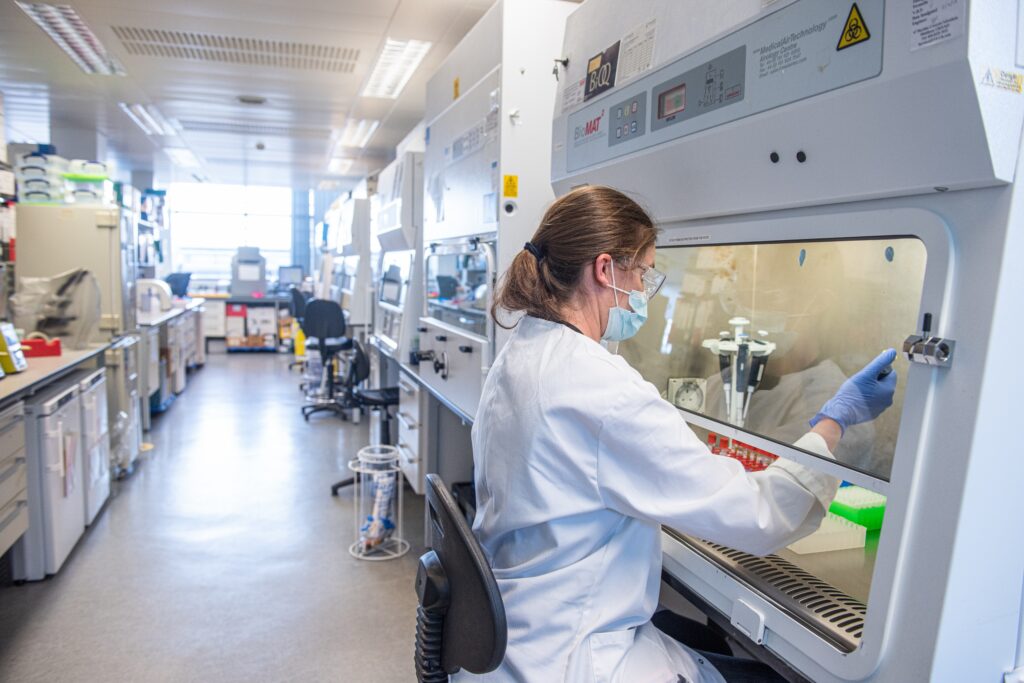
Three of those trials, all led by Oxford BRC-supported researchers, were fundamental to our national response: the development of the Oxford/AstraZeneca vaccine; the RECOVERY trial, which evaluated potential therapies for people hospitalised with severe COVID; and the PANORAMIC trial, which tested new antiviral treatments in the community.
Researchers across our entire BRC shifted their focus to the global emergency: leading efforts to test the efficacyof high-throughput antibody tests; using global pathogen sequencing to identify new variants; and leading the national population surveytracking the spread of the disease. We also developed a risk prediction modelthat informed the UK Government’s vaccine strategy by identifying vulnerable populations.
Our NIHR BRC infrastructure – along with the dedication and flexibility of individuals – gave us the agility and capacity to pivot rapidly and repurpose our resources to address the country’s and the world’s most pressing needs. At the start of the pandemic, we were able to quickly reallocate our funding to ‘pump-prime’ high-impact COVID-19-related research. This ability to get the Oxford/AZ vaccine and RECOVERY trials up and running in record time was praised by the COVID Inquiry.
As we now reflect on 20 years of the NIHR and 19 years of our BRC, what lessons can we take from all of this? With our collaborators around the country, we are here to tackle the nation’s biggest health priorities, whether this is long-term challenges such as common chronic diseases or the institutional shifts outlined in the NHS 10-year plan; or more urgent, existential issues like responding to a pandemic.
During the pandemic, we were able to pivot rapidly. This was only possible because of the infrastructure established by long-term funding. Our successes do not arise suddenly during the current cycle of funding; the foundations are built during previous cycles. This isn’t a quick process. Only through sustained investment in our research infrastructure will we be able to continue to deliver for the nation and the NHS.